
Numerical Reasoning Test (2026): Complete Guide, Examples & Strategies
Everything you need to pass numerical reasoning tests — SHL format explained, all question types with fully worked examples, essential formulas, and expert preparation tips.
What is a Numerical Reasoning Test?
A numerical reasoning test is a timed psychometric assessment that measures your ability to interpret, analyse, and draw correct conclusions from numerical data — typically presented in tables, bar charts, line graphs, and pie charts. It is one of the most commonly used assessments in graduate and professional recruitment across finance, consulting, technology, and management roles. Most employers use it alongside verbal reasoning and inductive reasoning tests as part of the full SHL battery.
A critical misconception is that numerical reasoning tests require advanced mathematics. They do not. The underlying calculations are GCSE / high-school level — percentages, ratios, fractions, basic algebra, and currency conversions. The real challenge is speed and accuracy under time pressure, and the ability to extract the right numbers from complex data before calculating.
- Reading tables, charts, and graphs accurately and quickly
- Performing calculations with percentages, ratios, and fractions
- Drawing logical conclusions from data — not from general knowledge
- Managing time pressure across 18–25 questions in 12–25 minutes
Numerical Reasoning vs General Maths Test
| Feature | Numerical Reasoning Test | General Maths Test |
|---|---|---|
| Data source | All answers come from provided tables/charts | Questions are self-contained |
| Maths difficulty | GCSE level — percentages, ratios, basic algebra | Can include advanced topics |
| Main challenge | Speed of data extraction + calculation accuracy | Mathematical knowledge and technique |
| Calculator | Usually permitted (on-screen) | Varies |
| Real-world context | Business scenarios — revenues, costs, headcount | Abstract or academic |
SHL Numerical Reasoning Test Format
What Each Question Looks Like
Each question presents a data set — usually one table or chart — followed by a question that requires you to extract specific values, perform a calculation, and select the correct answer from five options (typically including "Cannot Say"). Multiple questions can reference the same data set, which rewards reading the data carefully once rather than re-reading for each question.
Calculator Usage
Most SHL online numerical reasoning tests provide a basic on-screen calculator. However, some in-person supervised versions (particularly for certain industries or regions) may not. Always check the test instructions. Even with a calculator, practising mental arithmetic shortcuts is valuable — using the calculator for every sub-step slows you down significantly.
Before using your calculator on a numerical question, estimate the answer range in your head. This takes 3–5 seconds and prevents the most common error type: a calculator input mistake that gives a wildly wrong answer that you then confidently submit because you trust the calculator. If your calculated answer is far from your estimate, recalculate.
Essential Formulas & Mental Maths Shortcuts
These formulas cover approximately 80% of all numerical reasoning question types. Memorise them and practise applying them quickly — under time pressure, having these automatic removes cognitive load and saves 10–15 seconds per question.
Mental Maths Shortcuts Worth Knowing
- Finding 15%: Calculate 10% (shift decimal), then add half of that (5%). Faster than multiplying by 0.15.
- Finding 33.3%: Divide by 3. Finding 66.7%: divide by 3, multiply by 2.
- Percentage change check: If the answer choices are spread far apart, a rough estimate eliminates 3–4 options without calculating.
- Fractions-to-decimals cheat sheet: 1/8 = 0.125, 1/6 = 0.167, 1/3 = 0.333, 3/8 = 0.375, 5/8 = 0.625, 5/6 = 0.833. These appear frequently as percentage answers.
- Profit vs markup: Know the difference — profit margin uses revenue as the denominator, markup uses cost. These produce different percentages from the same numbers and a very common distractor pair.
All Question Types with Fully Worked Examples
The SHL numerical reasoning test uses five main question types, all grounded in business data scenarios. Below are fully worked examples for each type with step-by-step solutions.
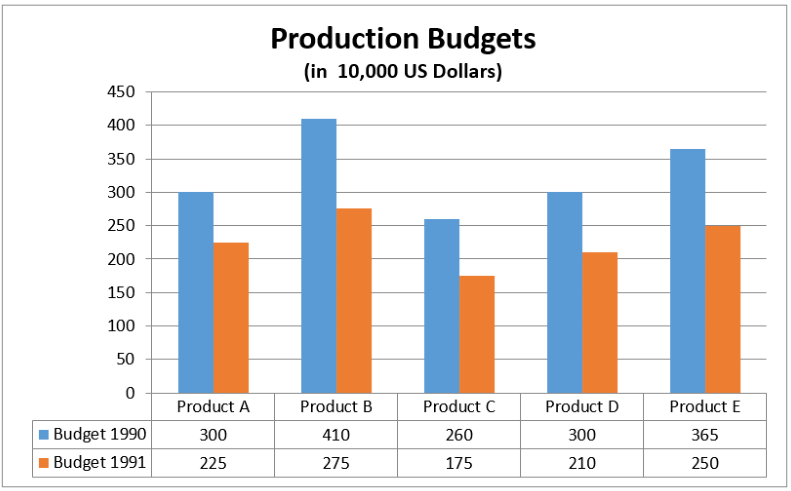
Our free numerical reasoning practice tests include full data sets with multiple questions, matching the exact SHL format you'll face in recruitment. Every question has a detailed step-by-step solution.
How to Read Charts & Tables Quickly
Most numerical reasoning errors happen before the calculation — candidates misread the table or extract the wrong value. Developing a systematic reading approach eliminates this error category entirely.
The 4-Step Data Reading Protocol
- Read the title first: Understand what the data set is measuring. This tells you the units and context before you read any numbers.
- Check the units carefully: Are values in thousands? Millions? Percentages? Currency? Note any multipliers stated in the table heading (e.g. "values in $000s").
- Identify the rows and columns relevant to the question before looking at the numbers. Do not scan the whole table — go directly to the intersection you need.
- Estimate your answer before calculating — this acts as a sanity check. If your calculated answer is dramatically different from your estimate, you've likely read the wrong cell or made a unit error.
Common Chart Types and What to Watch For
| Chart Type | What to Read Carefully | Common Error |
|---|---|---|
| Bar chart | Y-axis scale (especially if it doesn't start at zero), bar labels | Misreading bar height due to scale; confusing stacked vs grouped bars |
| Line graph | Two axes (often different units); which line corresponds to which category | Reading the wrong line; confusing left and right y-axes |
| Pie chart | Whether values are percentages or absolute; total sample size if given | Treating percentage slices as absolute counts (or vice versa) |
| Data table | Row and column headings; units in the header row; footnotes | Reading the wrong row/column intersection; missing a multiplier in the header |
| Combined chart + table | Which questions refer to the chart vs the table | Using chart data for a table-only question |
How Numerical Reasoning Tests Are Scored
Your raw score (number of questions answered correctly) is converted into a percentile rank by comparing your performance against a norm group — typically graduates or professionals at a similar level.
| Percentile | Performance Level | Typical Employer Implication |
|---|---|---|
| 90th+ | Excellent — top 10% of norm group | Strong pass; likely to progress at competitive employers |
| 70th–89th | Above average | Pass at most employers; borderline at highly selective ones |
| 50th–69th | Average | May or may not pass depending on employer's cut score |
| Below 50th | Below average vs norm group | Likely filtered at screening stage for competitive roles |
For most competitive graduate programmes, 70th percentile or above is considered strong. For highly selective employers (investment banking, top consulting, trading firms), 80th–90th percentile may be required. Employers use graduate-level norm groups — meaning you're being compared against other graduates, not the general population.
Which Companies Use Numerical Reasoning Tests?
Numerical reasoning tests are one of the most universally used assessments in graduate and professional hiring. The SHL numerical reasoning test is the most common format, administered via TalentCentral.
| Sector | Example Companies |
|---|---|
| Finance & Accounting | HSBC, J.P. Morgan, Goldman Sachs, Barclays, Morgan Stanley, Macquarie |
| Consulting & Professional Services | Deloitte, PwC, KPMG, EY, McKinsey, BCG, Accenture |
| Engineering & IT | Siemens, IBM, Cisco, Rolls-Royce, BAE Systems |
| Consumer Goods & Retail | Unilever, Nestlé, Amazon, Procter & Gamble |
| Other | Qantas, Shell, BP, NHS graduate schemes, Civil Service Fast Stream |
For a full breakdown, see our company-by-company guide.
Preparation Strategy
Numerical reasoning is one of the test types most responsive to focused preparation. The following strategy is designed to address the two root causes of poor performance: weak calculation skills and slow data reading. See our full SHL preparation guide for a broader 3-week plan covering all test types.
Week 1: Foundations
- Memorise all 8 formulas from Section 3. Test yourself until you can write them from memory without checking.
- Practise mental maths shortcuts daily: 10–15 percentage calculations without a calculator (finding 10%, 5%, 15%, 25%, 33%, 75%).
- Practise data reading: Find any table or chart (financial news, business reports) and practise extracting specific values quickly without reading surrounding text.
Week 2: Practice Questions with Review
- Complete 20–30 practice questions per day from our free practice tests.
- For every incorrect answer: identify whether the error was a formula error (wrong method), a data error (wrong cell), or a calculation error (right method, arithmetic mistake). Keep a tally. This diagnoses whether to focus more on formulas or data reading.
- Use a calculator for practice — but practise the "estimate first" habit before every calculation.
Week 3 (Pre-Test): Timed Full Mocks
- Complete full 25-question timed mocks under real conditions — no phone, no other tabs, same device as test day.
- Target: less than 60 seconds per question average.
- On the final day before the test: light review only. Do not attempt a full mock the evening before.
Common Mistakes to Avoid
Not practising under timed conditions
Most candidates can answer numerical questions correctly given unlimited time. The test challenge is accuracy under time pressure. Always practice with a timer — without it, you're not preparing for the actual test experience.
Misreading units or scale
The single most common source of wrong answers. Before calculating, always note the unit (thousands? millions?) and any multiplier in the table header. A $000s table with a ×$10,000 note means values must be multiplied by $10,000 — not $1,000.
Confusing profit margin and markup
"Margin" = profit ÷ revenue. "Markup" = profit ÷ cost. These give different percentages from the same numbers and are frequently offered as adjacent answer options to catch candidates who mix them up.
Multiplying (not dividing) for reverse percentage calculations
If a price is already discounted by 20%, the original price is NOT current price × 1.20. It is current price ÷ 0.80. This is the most common percentage calculation error and it features in the answer choices as a deliberate trap.
Overcomplicating questions — not using the answer choices
When answer options are spread far apart, a rough estimation eliminates 3–4 options without any calculation. Only calculate precisely when the options are close together. Using answer choices as a guide saves significant time.
Leaving questions blank when running out of time
SHL numerical tests do not penalise wrong answers. An unanswered question scores zero. With 2 minutes left and 3 questions remaining, guess B (or whichever option you lean toward) for all three. A 20–25% chance is always better than zero.
Frequently Asked Questions
Ready to Practice Numerical Reasoning?
Access our free SHL-style numerical reasoning practice tests — full data sets, worked solutions, and realistic time pressure.