
Deductive Reasoning Test (2026): Complete Guide, Examples & Strategies
Everything you need to pass the SHL Verify G+ deductive reasoning test — all 5 question types with screenshots, scoring explained, and proven strategies.
What is a Deductive Reasoning Test?
A deductive reasoning test is a psychometric assessment that measures your ability to take a set of given rules or premises and apply them logically to reach a valid, certain conclusion. It is essentially a structured logic test — rather than guessing or relying on general knowledge, you are expected to use systematic, top-down thinking to solve a defined problem.
The most common version in corporate recruitment is the SHL Verify G+ Test, which uses an interactive format with five distinct question types — each requiring a different kind of logical constraint-solving. It is widely used across finance, consulting, technology, and engineering roles.
Unlike numerical or verbal reasoning tests — where the challenge is speed and accuracy — deductive reasoning tests challenge your capacity to hold multiple constraints in mind simultaneously and systematically eliminate impossible solutions. The difficulty ramps up as more variables and constraints are added.
What Deductive Reasoning Tests Measure
| Cognitive Skill | How It's Tested | Why Employers Value It |
|---|---|---|
| Logical constraint-solving | Assigning people/items to slots based on rules | Problem-solving in ambiguous situations |
| Working memory | Holding multiple conditions in mind while solving | Complex decision-making; managing competing priorities |
| Systematic elimination | Ruling out impossible configurations | Data analysis; risk assessment |
| Pattern recognition under rules | Ranking and ordering based on performance data | Strategic planning; analytical roles |
| Spatial and temporal reasoning | Calendar and schedule-based problems | Project management; coordination roles |
Deductive vs Inductive Reasoning
These two reasoning types are often confused. Understanding the distinction helps you approach each test type with the correct mental framework.
🔽 Deductive Reasoning (Top-Down)
Starts with a general rule or set of premises and applies them to reach a certain, guaranteed conclusion.
- "All mammals are warm-blooded."
- "All dolphins are mammals."
- ∴ "All dolphins are warm-blooded." ✓ (must be true)
If the premises are true and the logic is valid, the conclusion must be true.
🔼 Inductive Reasoning (Bottom-Up)
Starts with specific observations and draws a probable, but not guaranteed conclusion.
- "Every swan I've seen has been white."
- ∴ "All swans are probably white." (likely but not certain)
The conclusion is likely but could be overturned by new evidence (black swans exist).
In a deductive test, the answer must follow from the rules provided — not from your general knowledge or assumptions. If the question says "all team members prefer morning meetings," you apply that as a given truth, even if you know that's unlikely in reality.
| Feature | Deductive Reasoning Test | Inductive Reasoning Test |
|---|---|---|
| Reasoning direction | General → Specific (top-down) | Specific → General (bottom-up) |
| Certainty of conclusion | Guaranteed if premises are true | Probable, not guaranteed |
| Question format | Scheduling, grouping, ranking, calendars | Shape/pattern sequences |
| Main provider | SHL Verify G+ | SHL Inductive Reasoning (12Q / 20min) |
| Key skill | Constraint-solving, systematic elimination | Pattern recognition, abstract thinking |
SHL Verify G+ Test Format
The SHL Verify G+ is the most common deductive reasoning test in corporate recruitment. It is an IQ-based exam that combines logical, deductive, and mathematical question types in an interactive drag-and-drop interface.
Two Variants
| Variant | Questions | Time | Format | Notes |
|---|---|---|---|---|
| Variant 1: Multiple Choice | 30 | 36 min | Select correct answer from options | Less common; elimination techniques apply directly |
| Variant 2: Interactive | 24 | 36 min | Drag-and-drop interface | Most common version; ~90 seconds per question |
Adaptive Difficulty — What This Means for You
The SHL Verify G+ uses computer-adaptive testing (CAT). If you answer a question correctly, the next question becomes harder. If you answer incorrectly, it becomes easier. This means:
- All candidates will find the test extremely challenging — this is by design, not a sign that you're performing badly.
- Not completing all questions within the time limit is normal and expected. Leaving questions unanswered does not automatically indicate poor performance.
- The scoring algorithm considers both your accuracy and the difficulty level of the questions you attempted.
- Do not slow down deliberately — attempting more questions at your natural ability level is better than answering fewer carefully.
Leaving a large number of questions unanswered — rather than running out of time naturally — can negatively impact your score. Always attempt an answer, even a quick best-guess, rather than leaving questions entirely blank. The test is designed to find your ceiling — running out of time naturally is fine.
All 5 Question Types (with Examples)
The SHL Verify G+ contains five distinct question types. Each type requires a different approach. Familiarising yourself with all five before test day is critical — encountering an unfamiliar format mid-test costs significant time and focus.
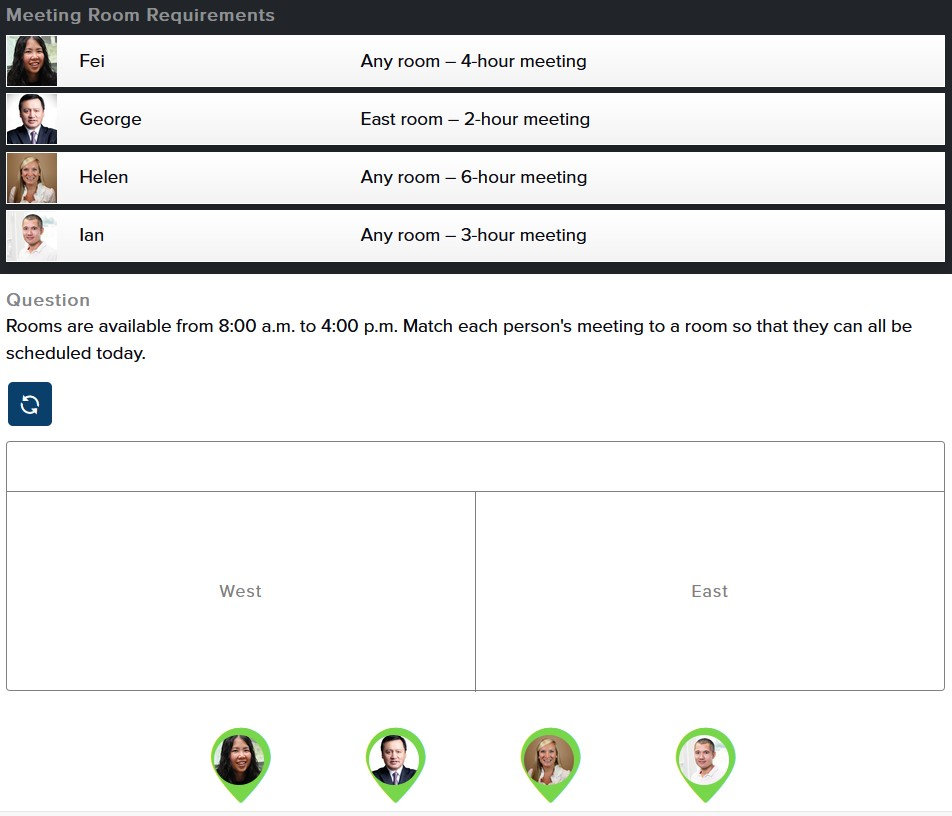
How to answer:
- Read all constraints before attempting any assignments — later constraints often invalidate early assumptions.
- Start with the most constrained individual (the one with the fewest possible valid rooms) and assign them first.
- Drag the green individual pins into the room slots that satisfy all conditions.
- Use the blue reset button to clear all pins if you need to start over.
- Double-check every constraint is satisfied before confirming.
Later questions in this type introduce more individuals, more rooms, and more constraints — often including conditional rules ("Person A can only share a room with Person B if Person C is not present"). Build your speed on simpler versions before tackling harder ones.
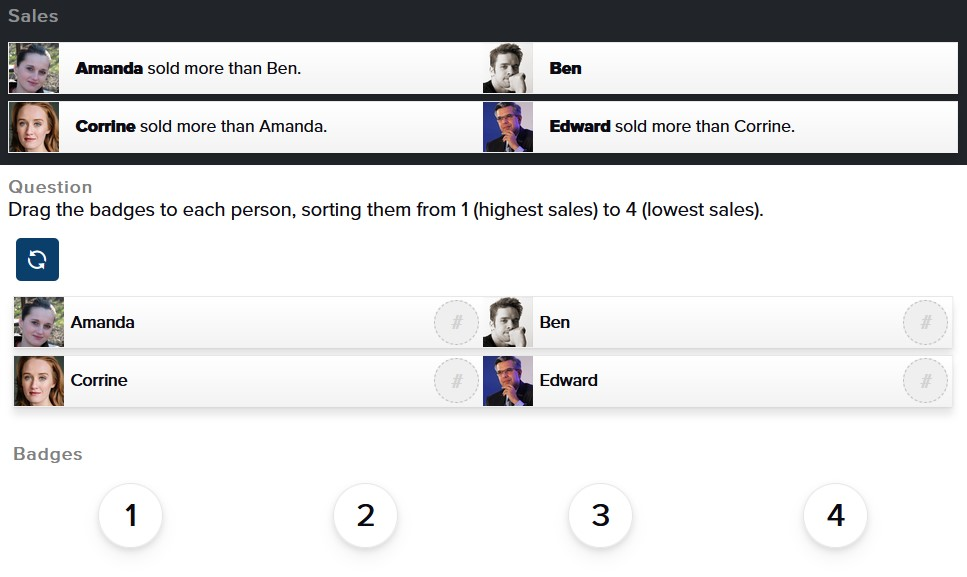
How to answer:
- Read all performance statements and identify direct comparisons (A > B, C < D).
- Build a chain: if A > B and B > C, then A > B > C.
- Drag ranking numbers to the placeholder circles next to each individual.
- Watch for indirect comparisons that must be inferred through chains.
- Use the reset button to restart if you find a contradiction.
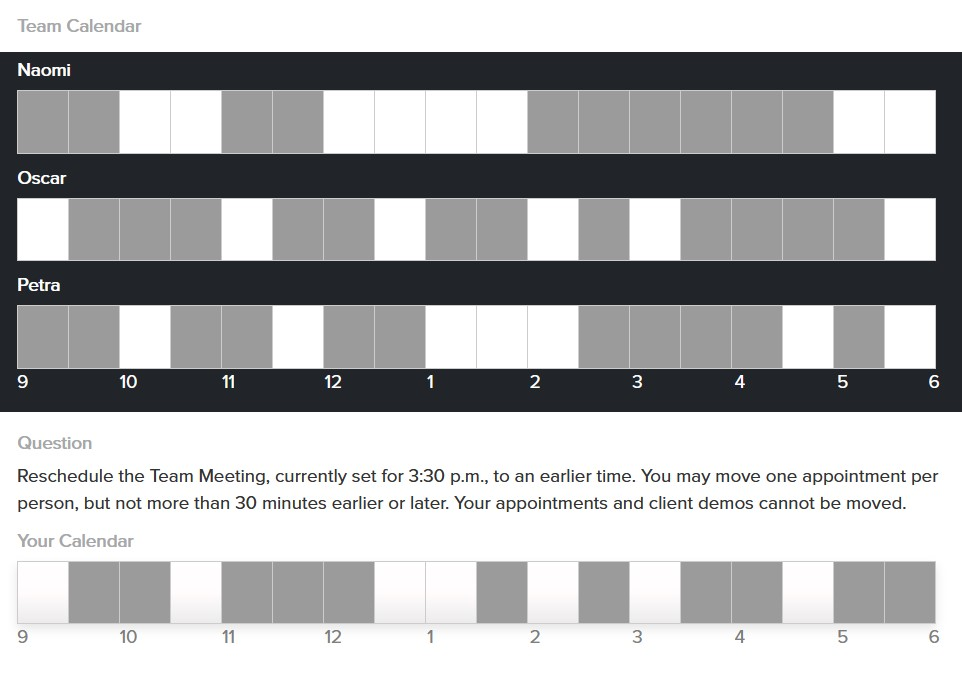
How to answer:
- Scan each person's schedule to identify their busy blocks and mark them mentally.
- Overlay the schedules to find windows where all required attendees are free.
- Check that the free window is long enough for the required meeting duration.
- Click on empty white blocks to select the valid time slot — blocks change colour to indicate your selection.
- Confirm the selection satisfies the duration requirement before moving on.
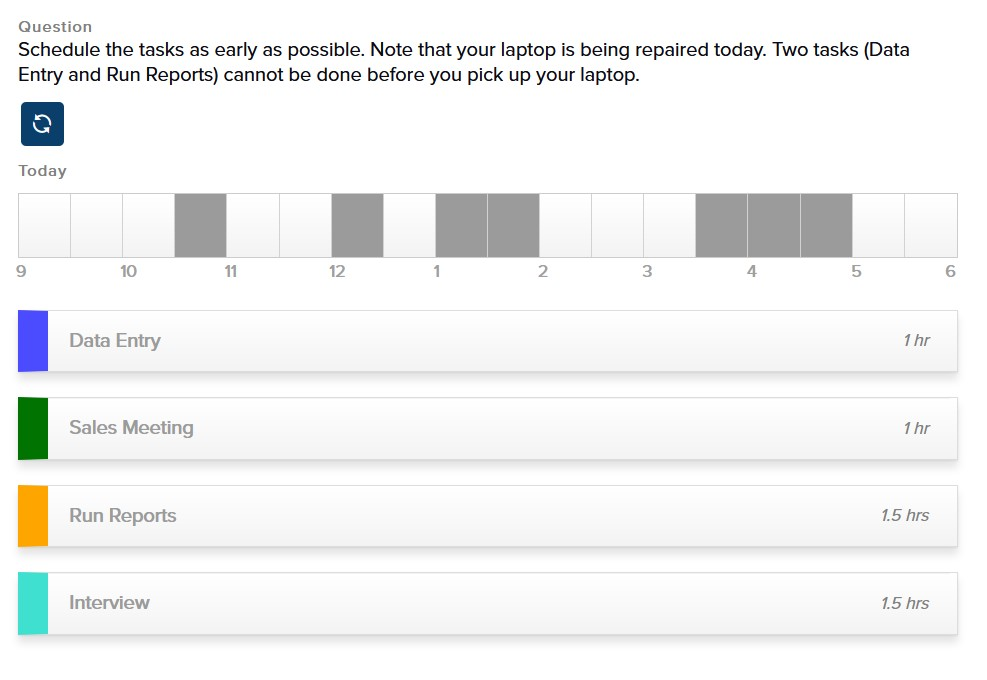
How to answer:
- Identify tasks with prerequisite dependencies — these must be scheduled first.
- Find the earliest available slot that satisfies the prerequisite and duration requirements.
- Drag task rows to the appropriate free slots — slots change colour to match the task when placed correctly.
- Continue until all required tasks are assigned.
- Verify ordering dependencies are respected — a task placed before its prerequisite is a violation.
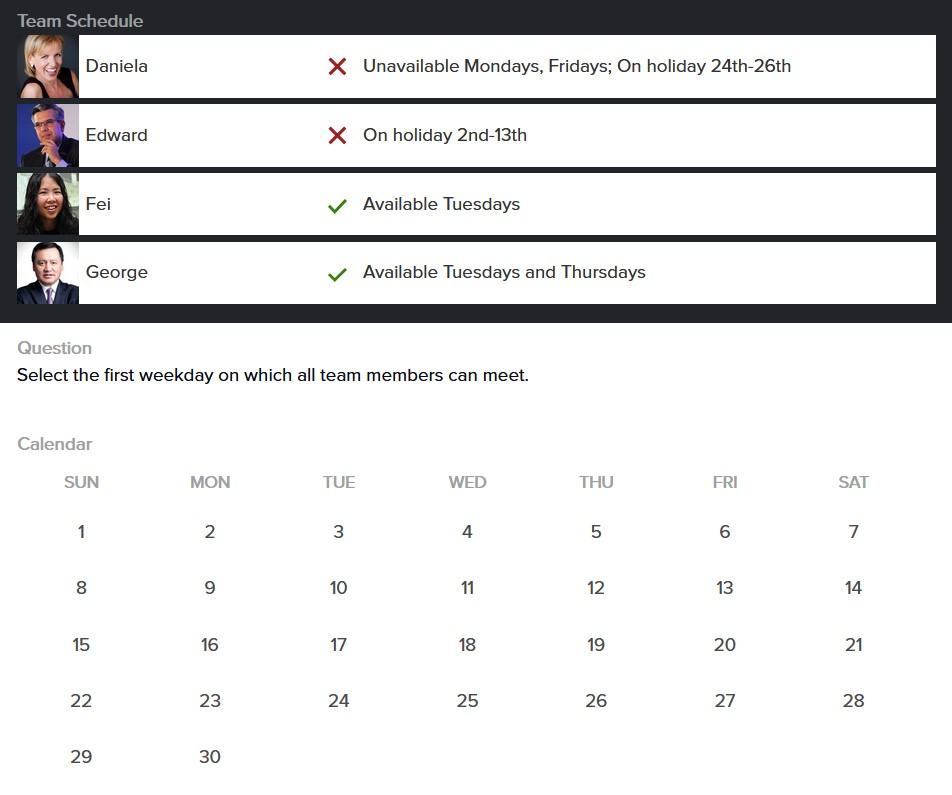
How to answer:
- Mark (mentally or on scratch paper) every blocked or unavailable day from all constraints.
- Eliminate days that violate any single constraint — you need ALL conditions to be met.
- Click on the calendar day that satisfies all remaining conditions.
- Later questions may require selecting multiple valid days — confirm each one satisfies all conditions independently.
More advanced calendar questions ask you to find multiple days that each meet all conditions. Confirm each day you select independently — don't assume adjacent valid days are automatically correct.
How the SHL Verify G+ is Scored
The SHL Verify G+ uses a sophisticated scoring model that goes beyond simple right/wrong counting. Three factors combine to produce your final percentile score:
| Factor | What It Measures | Why It Matters |
|---|---|---|
| Work Rate | Number of questions you attempted within the time limit | Penalises leaving many questions unanswered; rewards attempting more |
| Hit Rate | Proportion of attempted questions answered correctly | Accuracy across all difficulty levels attempted |
| Question Level | Difficulty of questions reached, adjusted dynamically by the adaptive algorithm | Answering harder questions correctly earns more than answering easier ones |
These three factors are combined and then compared against a reference norm group at a given ability level, producing a population percentile. The comparison group is typically calibrated for your career level and role type.
A score at or above the 75th percentile is generally considered strong and competitive for most roles. Top employers in finance, consulting, and law often require the 80th–85th percentile. Required scores are not publicly disclosed — aim to maximise your score rather than target a specific threshold.
Which Companies Use Deductive Reasoning Tests?
The SHL Verify G+ and similar deductive reasoning assessments are used across a broad range of sectors, particularly where roles require structured problem-solving, data analysis, or decision-making under constraints.
| Sector | Example Companies |
|---|---|
| Finance & Banking | Optiver, HSBC, Barclays, J.P. Morgan, Goldman Sachs |
| Consulting & Professional Services | PwC, Deloitte, EY, KPMG, Accenture |
| Technology & IT | IBM, Cisco, Experian, Capgemini |
| Engineering & Manufacturing | Siemens, General Electric, Rolls-Royce, BAE Systems |
| Public Sector & Civil Service | UK Civil Service Fast Stream, NHS, HMRC |
For a full breakdown of which tests specific companies use, see our company-by-company guide.
Preparation Strategies
Deductive reasoning is one of the most trainable cognitive skills — performance improves significantly with structured practice. Here is a focused preparation plan. For a broader 3-week schedule covering all SHL test types, see our full preparation guide.
Step 1: Learn All 5 Question Types Before Practising
The biggest mistake candidates make is starting practice tests before understanding the five question formats. At 75–90 seconds per question, encountering an unfamiliar type during the real test costs you 30–60 seconds of confusion time on that question alone. Review all five types above and understand the mechanics of each drag-and-drop interface before attempting any timed practice.
Step 2: Develop Systematic Constraint-Solving Habits
- Start with the most constrained element: In grouping and scheduling problems, identify the person or task with the fewest valid options and place them first. This reduces combinatorial complexity significantly.
- Use elimination, not trial-and-error: Systematically rule out impossible placements before testing valid ones. This is faster and less error-prone under time pressure.
- Build chains for ranking questions: Convert all pairwise comparisons into a single ordered chain. Draw it out on scratch paper if needed — the visual representation makes chain-building much faster.
- Mark constraints before touching the interface: For calendar and schedule questions, mentally (or physically on scratch paper) block out all unavailable windows before looking for free slots. This prevents you from missing a constraint that's listed at the bottom of the question.
Step 3: Practice Under Timed Conditions
Aim for ~75 seconds per question in early practice, then reduce to ~60 seconds as you improve. Use our free deductive reasoning practice tests to build speed and confidence across all five question types.
Step 4: Learn When to Guess and Move On
Given the adaptive format, spending 4 minutes on a single question while leaving 5 unanswered is always worse than spending 90 seconds on it, making a best guess, and moving on. Your work rate contributes to your score — do not sacrifice it for perfect accuracy on individual hard questions.
Common Mistakes to Avoid
Making assumptions beyond the given constraints
Only use information explicitly stated in the question. If a constraint is not listed, do not infer it from real-world logic. The deductive framework operates purely within the rules provided.
Ignoring qualifier keywords
Words like "all," "some," "only," "must," "can," "at least," and "at most" change the logic fundamentally. "All engineers prefer Room A" means something very different from "Some engineers prefer Room A." Read every constraint word for word.
Spending too long on hard questions
The adaptive format means hard questions will keep coming if you keep answering correctly. Don't spend more than 2 minutes on any single question — make your best logical guess, submit, and move on. Your work rate affects your score.
Starting with trial-and-error rather than elimination
Randomly placing items and checking if constraints are violated is slower than systematically eliminating impossible placements first. Build the habit of elimination-first problem solving before your test date.
Not reading all constraints before starting
A common trap in scheduling and grouping questions is to start placing items after reading two or three constraints, only to discover a later constraint invalidates every placement made so far. Always read the full constraint list first.
Frequently Asked Questions
Ready to Practice Deductive Reasoning?
Access our free SHL-style deductive reasoning practice tests and build the constraint-solving speed you need for test day.