
Inductive Reasoning Test (2026): Complete Guide, Examples & Strategies
Master pattern recognition with our complete guide to inductive reasoning tests — all question types, worked examples, the 5 pattern variables, and a proven preparation strategy.
What is an Inductive Reasoning Test?
An inductive reasoning test is a psychometric assessment that measures your ability to identify patterns in sequences of abstract shapes and figures, then use those patterns to predict the next element in the series. It is a pure measure of fluid intelligence — the capacity to solve novel problems that cannot be answered using prior knowledge or training.
Unlike verbal or numerical reasoning tests, inductive reasoning tests contain no text or numbers — just visual patterns. This makes them a relatively language-neutral and education-neutral measure of cognitive ability, which is one reason why employers value them for roles that require strong analytical thinking regardless of academic background.
Inductive reasoning tests measure fluid intelligence — the ability to reason in novel situations. This is distinct from crystallised intelligence (accumulated knowledge and learned skills), which verbal and numerical tests partly measure. Fluid intelligence is strongly linked to problem-solving ability, learning speed, and adaptability to new situations — all highly valued by employers.
What Inductive Reasoning Tests Measure
- Ability to identify patterns and trends in sequences of shapes and diagrams
- Ability to recognise logical progressions involving multiple simultaneous variables
- Ability to apply the process of elimination to narrow down possible answers efficiently
- Speed of pattern recognition under time pressure (~100 seconds per question)
- Working memory — holding multiple pattern rules in mind simultaneously
Inductive vs Deductive Reasoning
These two terms are often confused and sometimes used interchangeably, but they describe fundamentally different reasoning processes — and very different test formats.
| Feature | Inductive Reasoning | Deductive Reasoning |
|---|---|---|
| Direction | Specific observations → general conclusion (bottom-up) | General rules → specific conclusion (top-down) |
| Certainty of conclusion | Probable — could be wrong with new evidence | Guaranteed — must be true if premises are true |
| Test format | Abstract shape and pattern sequences | Scheduling, grouping, ranking, calendar problems |
| Main SHL test | SHL Inductive Reasoning (12Q / 20min) | SHL Verify G+ (24–30Q / 36min) |
| Key skill measured | Pattern recognition, fluid intelligence | Logical constraint-solving, systematic elimination |
| Visual or text-based | Visual only — shapes and diagrams | Mixed — text constraints with visual interface |
Many employers administer both inductive and deductive reasoning tests as part of the same hiring process — often alongside numerical and verbal reasoning. Prepare for both if you are unsure which variants you'll face. See our deductive reasoning guide for the SHL Verify G+ specifically.
SHL Inductive Reasoning Test Format
How Each Question Works
Each question presents a sequence of 5–6 abstract shapes or figures. The shapes change across the sequence according to one or more hidden pattern rules. You must identify those rules and select the shape from four or five multiple-choice options that correctly continues the sequence.
The challenge is not the complexity of any single rule — it's identifying all active rules simultaneously and applying them to select the one answer that satisfies every rule at once.
Difficulty Progression
Questions increase in difficulty as the test progresses — typically by introducing more simultaneous pattern variables, more subtle changes, or more complex combinations of transformation rules. Early questions often involve a single rule (e.g. shape rotates 90° clockwise each step). Later questions may involve four or five simultaneous rules operating independently.
You can use scratch paper to note pattern observations — many test-takers benefit from jotting down "Rule 1: shape rotates CW, Rule 2: dot count increases by 1" before selecting an answer. This externalises working memory and reduces errors on complex questions.
The 5 Core Pattern Variables
Almost every inductive reasoning question is built from combinations of these five pattern variable types. Learning to recognise each one instantly is the foundation of strong performance. Once you can identify which variables are active in a sequence, the question becomes a matter of applying the rules — not discovering them under pressure.
When you encounter a new sequence, scan all five variables in order: Number → Size → Colour → Rotation → Position. Identify which variables are changing and which are constant. Then apply all changing rules to the last element in the sequence to determine the correct next step. This systematic approach prevents you from missing a variable under time pressure.
Question Types with Worked Examples
Below are the four main inductive reasoning question types you'll encounter, each with a worked image example and step-by-step answer explanation.
Shapes change in a predictable progression across the sequence — typically involving number of sides, number of elements, or a combination of shape type and count. The pattern often involves two simultaneous rules (e.g. alternating shape type while number of points increases).
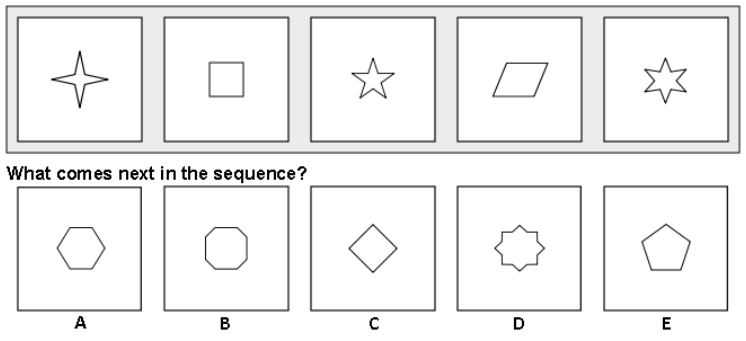
The sequence alternates between a star (with an increasing number of points: 4 → 5 → 6) and a four-sided shape. Since the last shape in the sequence is a star, the next shape must be a four-sided shape. From the options provided, the only four-sided shape is Option C. Rule 1: shape type alternates (star / four-sided). Rule 2: star point count increases by 1 each time a star appears. Both rules must be checked — the answer satisfies both.
Elements move around a fixed frame — typically a polygon's edges or vertices — following a rule about which edge or position receives the next addition. Requires tracking the position of the most recently added element and applying the movement rule from there.
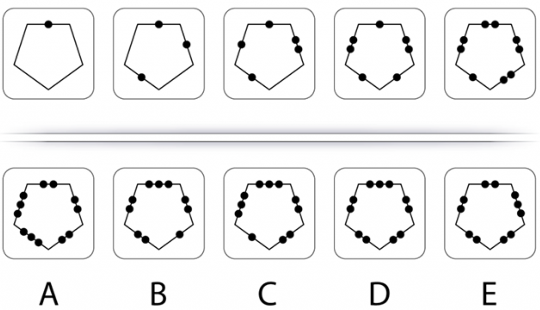
Looking at the difference between each consecutive shape: a dot is added to the 1st edge (relative to the last dot added) and 3rd edge, counting clockwise. In the 5th picture, the last dot was added to the bottom-right edge. Counting clockwise from there: 1st edge = bottom-left; 3rd edge = top. Therefore the next shape has dots added to the bottom-left edge and the top edge — Option D.
Multiple rules operate simultaneously on different properties of the same shape. This is the most complex type — identifying four or five simultaneous rules and applying all of them to reach the unique correct answer. Elimination is essential.
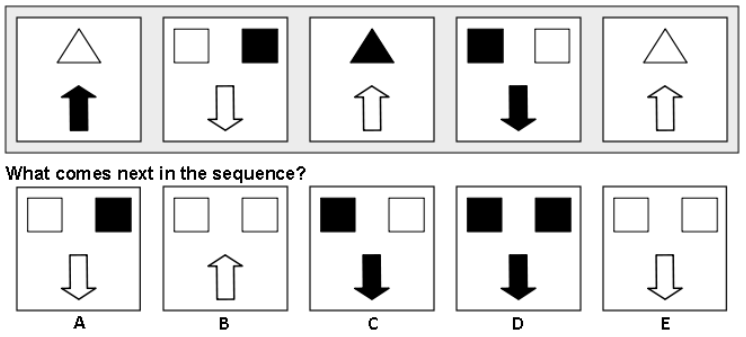
Rule 1: The pattern alternates between one triangle and two squares — the correct option must contain two squares. All five options remain.
Rule 2: The arrow direction alternates up / down — must be pointing down, giving options A, C, D, E.
Rule 3: There is always one black and one white square — options A or C remain.
Rule 4: The top-left square alternates colour — must be white on the left — gives Option A as the only answer satisfying all four rules simultaneously.
Elements within a figure undergo a sequence of transformations involving mirroring and rotation, applied independently to different components of the same shape. Requires tracking each component separately and identifying its individual transformation rule.
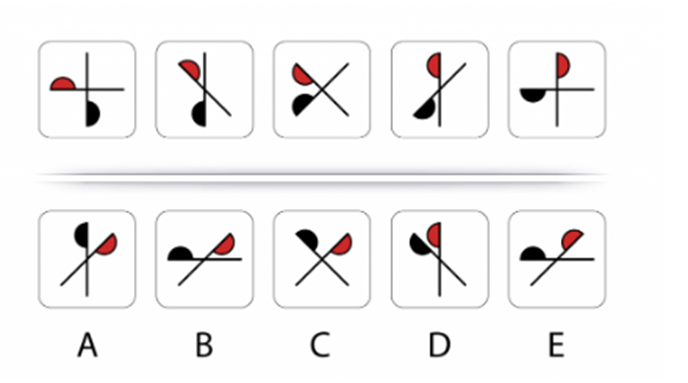
Rule 1 (black flag): Rule is mirror on its own axis first, then rotate 45° clockwise.
Rule 2 (red flag): Rule is rotate 45° clockwise first, then mirror on its own axis. These are the same two operations in reverse order — a common mirror question design. Track each element's rule independently and apply them to determine the next state. The only option matching both elements simultaneously is Option B.
The Elimination Method
The process of elimination is the single most important technique for inductive reasoning tests. Rather than trying to construct the perfect answer from scratch, work through each answer option systematically and eliminate those that violate any pattern rule you've identified.
Scan the sequence for all 5 variable types — Number, Size, Colour, Rotation, Position. Note which are changing and which are constant.
Identify the rule for each changing variable — "Shape rotates 90° clockwise each step," "Dot count increases by 1," "Shading alternates solid/outline."
Apply your most certain rule to eliminate answer options — Start with the rule you're most confident about. Cross out any options that violate it. Usually this eliminates 2–3 options immediately.
Apply each remaining rule to the surviving options until only one answer remains.
If two options remain, look for a subtle rule you may have missed — often a small positional change or a colour swap that distinguishes the two.
Trying to mentally build the "perfect" next shape from all rules simultaneously is slow and error-prone. Elimination is faster because each rule only needs to be applied once per option — not reconstructed from scratch. With four options and two rules, elimination takes 8 checks. Constructing the answer and verifying it takes significantly more cognitive effort.
Which Companies Use Inductive Reasoning Tests?
Inductive reasoning tests are used across a broad range of industries wherever problem-solving, analytical thinking, and learning potential are critical success factors. The SHL Inductive Reasoning test is the most common format.
| Sector | Example Companies |
|---|---|
| Technology & IT | Microsoft, IBM, Cisco, Accenture |
| Engineering & Manufacturing | Siemens, General Electric, Airbus, BAE Systems |
| Finance & Banking | J.P. Morgan, HSBC, Barclays, Goldman Sachs |
| Consulting & Professional Services | PwC, Deloitte, EY, KPMG |
| Graduate schemes (general) | Unilever, Nestlé, Shell, BP, NHS |
The SHL Inductive Reasoning test is frequently administered alongside numerical and verbal reasoning tests as part of a full cognitive assessment battery.
Preparation Strategy
Inductive reasoning performance improves with targeted practice more reliably than most other cognitive test types. The key is not just doing more questions — it's building specific habits and mental frameworks that translate directly to the test.
1. Learn the 5 Variables First (Before Practising)
Before attempting any practice test, memorise the five pattern variable types: Number, Size, Colour, Rotation, Position. Practising without this framework means rediscovering the same rules from scratch on every question — which is slow and inconsistent. With the framework internalised, each question becomes a rapid scan rather than a discovery process.
2. Daily Pattern Drills (10–15 Questions Per Session)
Daily exposure to pattern sequences improves fluid intelligence faster than massed practice (doing 100 questions in one session). Aim for 10–15 questions per day, 5–6 days per week, for 2–3 weeks. Use our free inductive reasoning practice tests for realistic SHL-style questions.
3. Practise the Elimination Method Explicitly
Do not just select answers intuitively. For every practice question, write out (or say aloud) your rules before looking at the options, then eliminate options one rule at a time. This builds the systematic habit you need under timed conditions.
4. Build to Timed Conditions Gradually
- Week 1: Untimed practice — focus on identifying all rules correctly, regardless of speed.
- Week 2: 2 minutes per question — accuracy with moderate time pressure.
- Week 3 (test prep): 90 seconds per question — real test conditions. Full 20-minute mock tests.
5. Review Every Incorrect Answer
After each practice session, review every incorrect answer and identify which rule you missed. Keep a running log of your most common error patterns (e.g. "I consistently miss positional changes" or "I'm slow to spot rotation in complex shapes"). Target your weakest variable types in subsequent practice.
Common Mistakes to Avoid
Not scanning all 5 pattern variables before answering
Most errors come from identifying 2–3 rules and missing a 4th or 5th that eliminates an apparent answer. Always check all five variable types before committing to an answer.
Ignoring rotation and mirror transformations
Rotations and reflections are among the most commonly missed rules, particularly in complex questions where they're subtle (e.g. a 45° rotation on a symmetric shape). Explicitly check for rotation on every question.
Overcomplicating simple questions
Not every question has four or five active rules. Start by checking for the simplest possible rule first — you'll be surprised how often a single rotation or colour alternation is the only change. Don't invent complexity that isn't there.
Spending more than 2 minutes on a single question
If you've spent 2 minutes and haven't identified the full pattern, make your best guess and move on. There are only 12 questions in 20 minutes — a single question cannot take 4 minutes without putting the whole test at risk.
Answering by gut feel rather than rule-based elimination
Intuitive answers may work on easy questions, but fail on harder ones where two options look similar. The elimination method protects against this — a systematic process cannot be fooled by a cleverly designed distractor.
Frequently Asked Questions
Ready to Practice Inductive Reasoning?
Access our free SHL-style inductive reasoning practice tests and start building your pattern recognition speed today.