Complete 2026 Guide

Psychometric Tests Explained: Complete Guide & Examples (2026)

Everything you need to know about psychometric tests — definitions, all test types with worked examples, major providers, how scoring works, and how to prepare.

3Main test categories
7Test types with examples
10+Major providers covered
2026Fully updated

What is a Psychometric Test?

A psychometric test is a scientific, standardised assessment designed to measure a person's mental capabilities, behavioural traits, and personality characteristics. The term "psychometric" comes from the Greek words for mind (psyche) and measurement (metron) — literally, measuring the mind.

Psychometric tests are used by employers across the world to evaluate job candidates objectively, going beyond what resumes and unstructured interviews can reveal. They produce quantifiable, comparable scores that allow recruiters to assess large numbers of candidates consistently and fairly.

🧠
Psychometric test vs aptitude test — what's the difference?

All aptitude tests are psychometric tests, but not all psychometric tests are aptitude tests. The psychometric umbrella covers both cognitive ability tests (numerical, verbal, inductive reasoning — which have right and wrong answers) and personality questionnaires (OPQ32, MBTI, Big Five — which have no correct responses). When employers say "psychometric test," they usually mean a combination of both.

CategoryRight/Wrong Answers?What It MeasuresExamples
Cognitive ability (aptitude)YesHow well you process information, reason, and solve problemsSHL Numerical, Verbal, Inductive, Deductive
Personality & behaviourNoHow you typically behave, communicate, and relate to othersSHL OPQ32, Hogan, Big Five, DISC
Situational judgementBest/worst answerDecision-making in realistic work scenariosSJTs used by NHS, law firms, Big Four
Job-specificYesSkills specific to a particular role or industryMechanical reasoning, PILAPT (aviation), coding tests

Why Employers Use Psychometric Tests

  • Objective screening at scale: A popular graduate role receives thousands of applications. Psychometric tests create a consistent, comparable filter that doesn't rely on subjective CV screening.
  • Predictive validity: Meta-analyses show cognitive ability tests predict job performance more reliably than unstructured interviews (validity coefficient ~0.51 vs ~0.38). Employers pay for tests because they work.
  • Bias reduction: Standardised tests apply identical conditions to every candidate, removing some of the subjectivity and social similarity bias that affects traditional interviews.
  • Personality and culture fit: Personality questionnaires help employers understand whether a candidate's working style aligns with the team, management approach, and company culture.
  • Cost efficiency: Filtering 5,000 applicants to 500 using an online test battery is vastly cheaper than interviewing all 5,000.

Types of Psychometric Tests

🔢
Numerical Reasoning
Tables, charts, graphs. Tests percentages, ratios, data interpretation. Used in finance, consulting, and engineering recruitment.
Full guide →
📝
Verbal Reasoning
Written passages with True/False/Cannot Say questions. Tests reading comprehension and critical inference.
Full guide →
🔷
Inductive / Abstract Reasoning
Abstract shape sequences. Tests pattern recognition and fluid intelligence — the ability to solve novel problems.
Full guide →
⚙️
Deductive Reasoning
SHL Verify G+. Scheduling, grouping, ranking, calendar problems. Interactive drag-and-drop format.
Full guide →
🧠
Personality Questionnaires
No right/wrong answers. Maps your behavioural tendencies across workplace dimensions. OPQ32 is most common in recruitment.
Full guide →
💬
Situational Judgement (SJT)
Realistic workplace scenarios. Select the most/least effective response. Common in law, NHS, civil service, and Big Four.
Practice tests →
🔧
Mechanical Reasoning
Gears, levers, pulleys, circuits. Used for engineering, technical trades, aviation, and military roles.
Practice tests →

Worked Example Questions

🔢 Numerical Reasoning — Percentage Change
A store sells a laptop for $1,200 after applying a 20% discount. What was the original price?
A
$1,300
B
$1,400
C
$1,500
D
$1,600
✓ Answer: C — $1,500
The sale price represents 80% of the original (100% − 20%). To reverse a discount: Original = Sale Price ÷ (1 − discount%) = $1,200 ÷ 0.80 = $1,500. Always divide — multiplying by 1.20 gives the wrong answer ($1,440).
📝 Verbal Reasoning — True / False / Cannot Say
Passage: "A recent study found that 80% of people prefer working from home, but only 60% of companies offer remote work options."
Statement: "Most companies allow employees to work remotely."
A
True
B
False
C
Cannot Say
✓ Answer: B — False
The passage states only 60% of companies offer remote work. "Most" requires more than 50% — and 60% is technically more than 50%, BUT the word "allow" implies it's widespread and normal, while the passage presents 60% as a limitation. More importantly, "most" in context implies a strong majority — and the passage treats 60% as a minority not meeting 80% demand. This is a False, not Cannot Say.
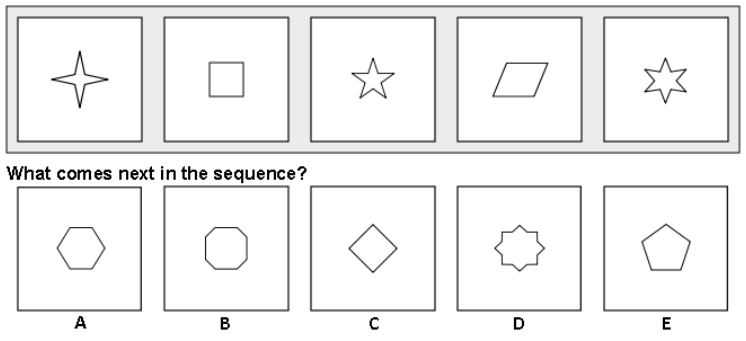
Logical Reasoning Pattern Recognition
Logical Reasoning Example Question
What comes next?
✓ Correct Answer: C
The shape alternates between a star (with an increasing number of points from 4 to 5 to 6), and a four-sided shape in between the stars to complete the sequence. Given the last shape in the sequence is a star, the next shape must be a 4 sided shape. From the options provided, the only 4 sided shape is Option C which is the correct answer.
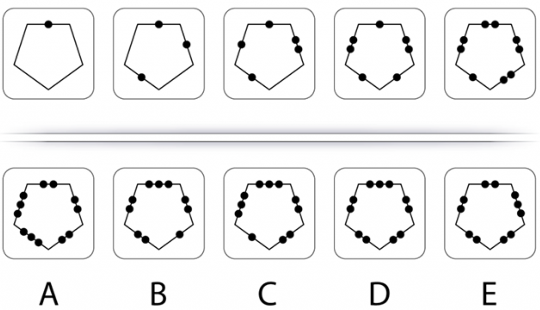
Inductive / Abstract Reasoning Pattern Recognition
Abstract Reasoning Example Question
What comes next?
✓ Correct Answer: D
If we look at the difference between the first and second shape, we can see that a dot gets added on the 1st edge and 3rd edge counting clockwise. For the second shape, starting on the last dot that was added on the 3rd edge, again dots are added on the 1st edge and the 3rd edge. This repeats itself the entire sequence.
Working through the remaining shapes, we can see in the 5th picture that the last dot was added on the bottom right edge. As such, the next shape in the pattern would have dots added on the 1st edge (bottom left) and 3rd edge (top edge). Hence, the correct answer is Option D.
🔧 Mechanical Reasoning — Gears
Gear A and Gear B are directly connected and meshing. If Gear A rotates clockwise, which direction does Gear B rotate?
A
Clockwise
B
Counterclockwise
C
It won't move
D
Not enough information
✓ Answer: B — Counterclockwise
When two gears are directly meshed, they always rotate in opposite directions. A third gear between them would make them rotate in the same direction again. Memorise this principle — it's one of the most tested mechanical reasoning facts.
💬 Situational Judgement (SJT)
Your colleague misses a deadline on a shared project, causing a delay that affects your team. What is the MOST effective response?
A
Report them to your manager immediately
B
Speak with your colleague directly to understand what happened and offer to help
C
Ignore the situation and focus on your own work
D
Complain to other colleagues about the impact
✓ Answer: B
SJTs reward proportionate, constructive, collaborative responses. Speaking directly addresses the root cause without unnecessary escalation. Option A skips proportionate steps. C and D are passive or counterproductive. In SJTs, direct and constructive communication is almost always the correct first step.

Major Psychometric Test Providers

Different employers use different test platforms. Understanding which platform you'll face allows you to practise with the most relevant question formats.

SHL TalentCentral
World's largest provider. Used by most FTSE 100 and Fortune 500 companies for graduate and professional hiring.
Korn Ferry (Talent Q)
Adaptive format tests. Used by Unilever, L'Oréal, and many multinationals. Questions adjust difficulty in real time.
Saville Assessment
Wave personality suite and Swift aptitude tests. Used by HSBC, BT, and NHS.
Hogan Assessments
Gold standard for senior/executive hiring. HPI, HDS (Dark Side), and MVPI reports.
Criteria Corp (CCAT)
Popular in the US. Covers numerical, verbal, and logical reasoning in a single 50-question test.
cut-e (Aon)
Grid-based and game-style aptitude tests. Used by Siemens, Deutsche Bank, Allianz.
Watson Glaser
Critical thinking assessment. Standard for law firms (Magic Circle, US Big Law) and civil service.
Arctic Shores
Game-based assessment platform. Used by PwC, AstraZeneca. Measures cognitive ability through gameplay tasks.
Talogy / Cubiks
Logiks assessments for graduate screening. Used by international organisations and NGOs.
Wonderlic
Short cognitive ability test (50Q / 12 min). Common in the US across many industries.

How Psychometric Tests Are Scored

Aptitude tests use norm-referenced scoring — your raw score is converted into a percentile that shows how you performed relative to a reference group (typically people at your career level or in similar roles). A score of 75th percentile means you outperformed 75% of the comparison group.

PercentileWhat It MeansEmployer Implication
90th+Top 10% of norm groupStrong pass at virtually all employers
75th–89thAbove averageCompetitive pass at most graduate employers
60th–74thModerately above averageBorderline — depends on employer's cut score
Below 60thAverage or belowOften screened out at competitive roles
💡
Personality tests are not scored the same way

Personality questionnaires (OPQ32, Hogan, Big Five) don't produce "good" or "bad" scores — they produce profiles. Results are mapped to competency frameworks relevant to the role. There is no pass/fail on a personality questionnaire — the question is whether your profile fits the role profile the employer is looking for.

How a Psychometric Assessment Is Conducted

  • Online invitation: You receive a unique email link from the test platform (e.g. TalentCentral) with a deadline — typically 48–72 hours.
  • Environment setup: Find a quiet room with a stable internet connection. Some tests use webcam monitoring to prevent cheating.
  • Instructions and practice questions: Each section begins with format instructions and unscored practice questions. Read carefully before the real test begins.
  • Timed completion: Once a section starts, the clock cannot be paused. Complete everything within the allocated time. Always submit an answer — never leave questions blank.
  • Automated scoring: Results are processed immediately. The employer receives a detailed percentile report and (for personality tests) a competency profile.
  • In-person re-sit: Most employers require shortlisted candidates to re-sit aptitude tests in person to verify online results. Significant score discrepancies trigger integrity reviews.

Preparation Tips

  • Identify the test provider first. Your invitation email usually names the platform (SHL TalentCentral, Korn Ferry, etc.). Targeted practice for that specific format is far more effective than generic preparation.
  • Take a timed baseline test before studying. Your first mock test under real conditions reveals your weakest areas — focus your effort there, not on areas where you're already strong.
  • Practice under timed conditions from day one. Untimed practice builds accuracy but not the time-pressure management the real test demands. Always use a timer.
  • Review every incorrect answer. Understanding why an answer was wrong — formula error, data reading error, pattern misidentification — prevents the same error recurring.
  • For personality tests, answer authentically. Modern personality questionnaires include social desirability scales that detect overly positive response patterns. Answer consistently as your genuine work self, not your ideal self.
  • Do not attempt to cheat. SHL detects tab switching, copy-paste, screenshots, and face detection. In-person re-sits verify online results. Preparation is both the ethical and the strategically correct approach.

Frequently Asked Questions

Can you fail a psychometric test?+
Aptitude tests don't have a formal pass/fail — instead, your percentile score is compared against the employer's cut score for that role. Scoring below the threshold means you don't progress. The threshold varies significantly by employer and role. Personality questionnaires cannot be "failed" but a profile mismatch with the target role may affect your progression.
What is the most common psychometric test in recruitment?+
The SHL TalentCentral battery (Numerical + Verbal + Inductive Reasoning) is the most widely administered cognitive test battery in corporate recruitment globally. The SHL OPQ32 is the most commonly used personality questionnaire. For law and civil service, Watson Glaser critical thinking is the dominant format.
How long does a psychometric test take?+
Aptitude tests: each section typically takes 17–25 minutes, with a full battery of 3 tests taking 50–75 minutes total. Personality questionnaires: 25–35 minutes. Game-based assessments: 20–30 minutes. The SHL Verify G+ deductive test: 36 minutes. Always check your specific test instructions for exact timing.
What is the difference between a psychometric test and an aptitude test?+
All aptitude tests are psychometric tests — but "psychometric test" is the broader term. Aptitude tests (numerical, verbal, inductive) have right and wrong answers and measure cognitive ability. Personality questionnaires (OPQ32, Big Five) are also psychometric but have no correct responses — they measure personality traits instead.
Can I prepare for a personality questionnaire?+
Not in the same way as aptitude tests — but you can prepare strategically. Understand the forced-choice format (where you must choose between equally positive-seeming options) so it doesn't surprise you. Reflect on your genuine work style before starting. Answer consistently throughout — inconsistency flags are built into most modern personality tools.

Ready to Practice?

Start preparing for your psychometric test with our free practice tests — full timed sessions with detailed answer explanations for every question.