
What is the SHL Aptitude Test? Complete Expert Guide (2026)
Everything you need to know about SHL tests — all four test types explained with worked examples, the Verify G+ deductive test, scoring, difficulty, and proven strategies to maximise your score.
What is the SHL Aptitude Test?
SHL (formerly Saville & Holdsworth Limited) is the world's largest provider of psychometric assessments. SHL aptitude tests are standardised, online cognitive ability tests used by employers to evaluate candidates' reasoning skills during the hiring process. They are administered through the SHL TalentCentral platform — a secure testing environment used by thousands of employers globally.
SHL tests are not general knowledge tests and they are not IQ tests. They measure specific, job-relevant reasoning skills — how quickly and accurately you can process numerical information, extract meaning from written text, identify abstract patterns, and draw logical conclusions from constraints. These skills correlate strongly with performance in analytical, graduate, and professional roles.
Companies including PwC, Deloitte, KPMG, EY, Goldman Sachs, J.P. Morgan, HSBC, Qantas, Macquarie Bank, the ADF, Shell, Siemens, and most ASX 100 and FTSE 100 graduate programs use SHL assessments as a primary screening tool. A strong result can mean the difference between progressing to interview and being filtered out early.
Unlike IQ tests, SHL aptitude test performance is directly improved by targeted practice. Familiarity with question formats, understanding of the scoring model, and time-management discipline — all of which come from structured preparation — typically produce 5–15 percentile point improvements. The question types are predictable; preparation pays off.
Why Do Employers Use SHL Tests?
Employers use SHL tests for three core reasons: efficiency, objectivity, and predictive validity.
- Efficiency at scale: A popular graduate scheme receives 5,000–20,000 applications. SHL tests filter this to the top 20–30% of candidates within hours, before expensive human review begins.
- Objectivity and consistency: Standardised tests apply identical conditions to every candidate, reducing the unintentional bias that affects CV screening and unstructured interviews.
- Predictive validity: Cognitive ability tests consistently outperform interviews and GPA as predictors of job performance — particularly for graduate-level analytical roles. Employers pay for tests because the research shows they work.
| Selection Method | Predictive Validity (r) | Notes |
|---|---|---|
| Cognitive ability test + structured interview | ~0.63 | Gold standard combination |
| Cognitive ability test alone | ~0.51 | Best single-method predictor |
| Structured interview alone | ~0.51 | Equally valid but expensive |
| Unstructured interview | ~0.38 | Most common, but least valid |
| GPA / academic results | ~0.32 | Useful but weaker predictor |
| Years of experience | ~0.18 | Very weak predictor at graduate level |
The Four SHL Test Types
🔢 Numerical Reasoning
📝 Verbal Reasoning
🔷 Inductive / Abstract Reasoning
⚙️ Verify G+ (Deductive Reasoning)
Numerical Reasoning — Worked Examples & Tips
The SHL Numerical Reasoning test presents information in tables, bar charts, line graphs, and pie charts. Questions require extracting the correct data values and applying GCSE-level calculations — percentages, ratios, currency conversions — under strict time pressure. A calculator is provided on-screen for most online versions.
Top Tips for Numerical Reasoning
- Estimate before calculating. A quick mental estimate of the expected magnitude eliminates 3–4 options and catches calculator input errors.
- Memorise the 8 core formulas before test day: % change, reverse %, margin, markup, ratio, speed-distance-time, currency conversion, % of total.
- Check units carefully. Tables labelled "$000s" require multiplying by 1,000. Hours: 45 minutes = 0.75h, not 0.45h.
- For multi-question datasets, use a spreadsheet. When several questions reference the same data table, building a quick formula in Google Sheets saves cumulative calculation time.
Verbal Reasoning — Worked Examples & Tips
The SHL Verbal Reasoning test presents short written passages followed by statements you must evaluate as True, False, or Cannot Say — using only the information in the passage. Background knowledge is irrelevant. This is the most common error.
Top Tips for Verbal Reasoning
- Read the statement before the passage. Know what you're looking for before you read — this saves 10–15 seconds per question.
- Default to Cannot Say when uncertain. When torn between False and Cannot Say, Cannot Say is almost always correct. False requires an explicit contradiction.
- Watch qualifier words: "all," "some," "most," "always," "prevents," "causes" — these words are the key to nearly every difficult question.
- Never use background knowledge. If it's not in the passage, it doesn't exist for this test.
Inductive Reasoning — Worked Examples & Tips
The SHL Inductive Reasoning test (also called Abstract Reasoning) presents sequences of abstract shapes. You must identify all active pattern rules and select the next shape in the sequence. Questions allow roughly 100 seconds each — but identifying multiple simultaneous rules requires systematic scanning, not guessing.
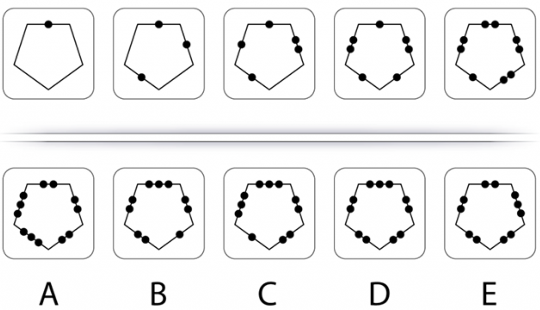
Top Tips for Inductive Reasoning
- Scan the NSCRP framework: Number, Size, Colour, Rotation, Position — check each in order before selecting an answer.
- Use elimination, not construction. Apply your most certain rule to eliminate options. Two rules usually leave one answer.
- Most commonly missed rules: 45° rotations on symmetric shapes, mirror reflections, positional movement around polygon edges.
- Practise building speed: Start untimed in week 1, reduce to 2 minutes in week 2, and 90 seconds in week 3.
SHL Verify G+ (Deductive Reasoning) — Examples & Tips
The SHL Verify G+ (also called the SHL General Ability Test or Deductive Reasoning test) is a different and more complex assessment than the standard SHL battery. It uses an adaptive, interactive drag-and-drop format and combines three question types: numerical, inductive, and deductive reasoning — all in one 36-minute test.
It is used specifically by employers requiring general reasoning across all three dimensions simultaneously — most notably the Australian Defence Force, Qantas, and Rolls-Royce. For the Verify G+, the deductive reasoning section is the hardest and most novel part.
Your score combines: (1) work rate — how many questions you attempted; (2) hit rate — your accuracy; (3) question level — how far up the adaptive difficulty curve you reached. This means attempting more questions, even with some errors, produces a higher score than perfect accuracy on fewer questions. Never stop early. Never leave questions blank.
Top Tips for the Verify G+
- Learn all 5 question types before practising. The drag-and-drop interface is unfamiliar. Format confusion costs 30–60 seconds per question. See our full deductive reasoning guide.
- Read ALL constraints before touching the interface. Assigning placements before reading everything forces backtracking. Read everything first.
- Assign most-constrained elements first. The element with fewest valid options should be placed before elements with more flexibility.
- Never exceed 2 minutes on any question. Guess from your best partial elimination and move on.
How SHL Tests Are Scored
SHL uses norm-referenced scoring. Your raw score (correct answers) is converted into a percentile by comparing your performance against a norm group — typically calibrated to people at your career level and in relevant industries. This means a 70% raw score might be the 80th percentile against a general graduate group but the 60th percentile against an investment banking analyst group.
| Percentile | What It Means | Typical Employer Implication |
|---|---|---|
| 90th+ | Top 10% of norm group | Strong pass at virtually all employers |
| 75th–89th | Above average | Competitive pass at most graduate roles |
| 60th–74th | Moderately above average | Borderline — depends on employer cut score |
| Below 60th | Average or below | Often screened out at competitive roles |
SHL tests do not apply a penalty for wrong answers. An unanswered question scores zero; a random guess among 5 options has a 20% chance of being correct. Eliminating even one wrong option before guessing improves your odds to 25%. Always submit an answer for every question, even with seconds remaining.
Test Difficulty & Norm Groups
The perceived difficulty of an SHL test depends heavily on which norm group your score is compared against. The questions themselves are the same — but your percentile rank differs based on who you're being compared to.
| Norm Group | Who It Applies To | Relative Difficulty |
|---|---|---|
| General population | Entry-level, non-graduate roles | Easier — broad reference group |
| Graduate | Most graduate scheme applications | Moderate — standard for most readers |
| Managerial/professional | Experienced hire and manager-level roles | Harder — compared against experienced professionals |
| Finance/quantitative | Investment banking, quant roles | Very hard — highly numerate reference group |
This is why preparation benchmarking matters — practising against a general norm group and scoring at the 75th percentile doesn't mean you'll be at the 75th percentile against an investment banking graduate cohort. Practise with tests calibrated to your target role level.
Common Mistakes to Avoid
Not preparing at all
The most common and most costly mistake. Competitors who practise score 5–15 percentile points higher on average. Going in cold puts you at a direct disadvantage against every prepared candidate in your applicant pool.
Practising without a timer
Untimed practice builds accuracy but not the time-pressure discipline the real test demands. Always use a timer from your very first practice session.
Using background knowledge in verbal reasoning
Answering based on what you know to be true rather than what the passage states is the single biggest source of incorrect answers on SHL verbal tests.
Getting stuck on hard questions
Spending 4 minutes on one deductive reasoning question while leaving three others unanswered always hurts your score. Set a per-question time limit and stick to it — guess and move on when you hit it.
Attempting to cheat
SHL TalentCentral detects tab switching, copy-paste activity, screenshots, and face detection. Most employers require an in-person re-sit at assessment centres that immediately exposes any discrepancy. See our full guide on SHL cheating detection.
Not reviewing incorrect answers
Completing practice tests without analysing wrong answers is the most common preparation inefficiency. Understanding why you got something wrong — which formula you misapplied, which rule you missed — is what actually prevents the error from recurring.
Frequently Asked Questions
Ready to Start Practising?
Access our free SHL-style practice tests for all four test types — full timed sessions with detailed answer explanations for every question.